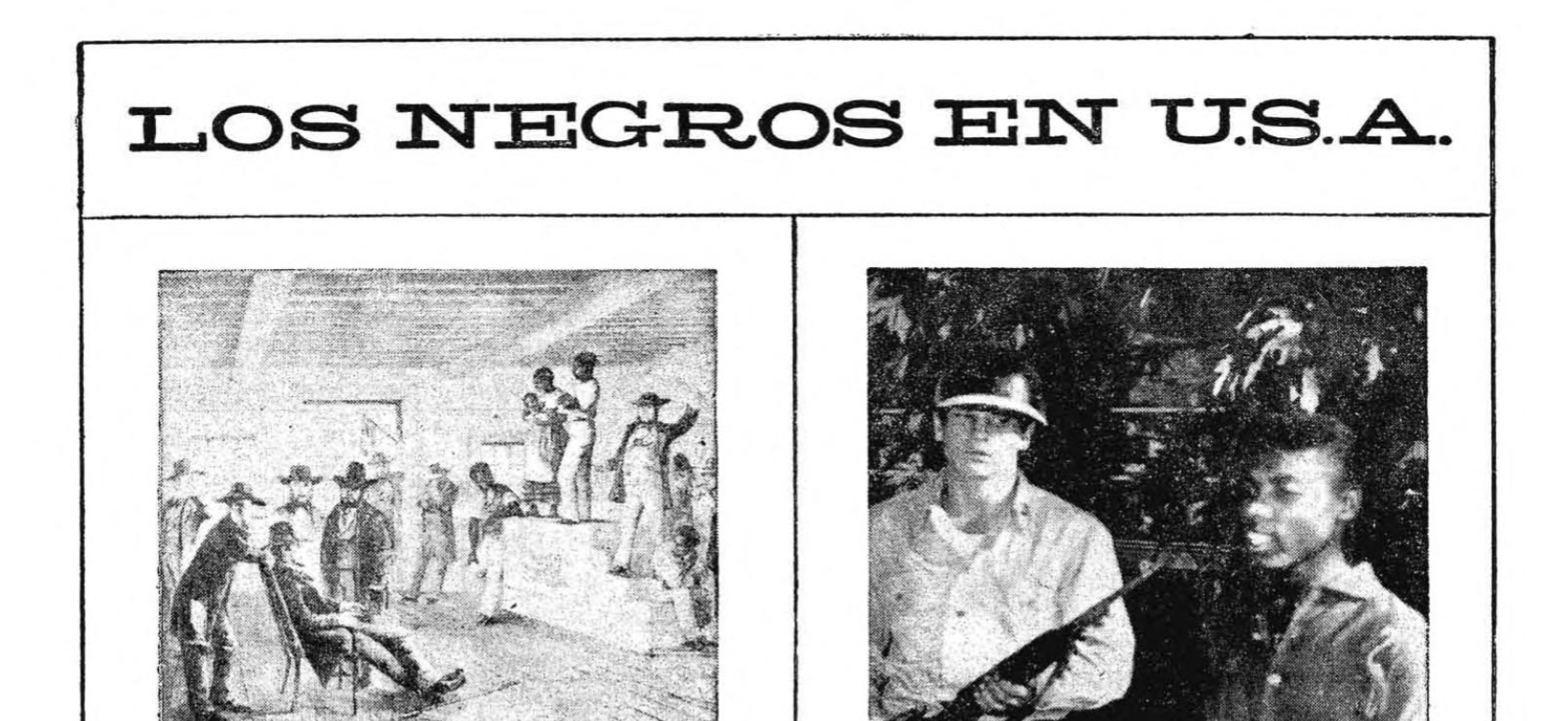
When I stumbled upon the “Negroes en U.S.A.” issue of Lunes de Revolución (Cuba, 1960), I thought it would be interesting to reflect back to those early years in the civil rights movement when the Cuban Revolution was a recent event that resonated around the world with iconic significance.
This journal, in particular this issue, featured some of the leading Black activists and intellectuals who shared their observations on the inequities, the prejudice, and yes the downright depravity of American society that existed in 1960.
Starting with the main editor of the magazine and his lead article, I wrote about Richard T. Gibson in the first installment. Little did I know that this would uncover a crazy quilt of international intrique and serious allegations that Gibson worked for the CIA!
Gibson denied this role, “If I’m CIA, where’s my pension?“
More recently, a Newsweek article revealed that there were “three fat CIA files on Gibson. According to these documents, he had served U.S. intelligence from 1965 until at least 1977.”
How tragic, I thought, looking back from sixty years later, to be piecing together the threads of complicity, betrayal, and ideological motivations that existed at the very heart of our struggles for freedom! Were the strongest voices advocating for social justice also part of secret intelligence operations? Does the act of revolution become diluted and hypocritical when we discover that the CIA, KGB, or other forces were constantly playing a hidden hand?
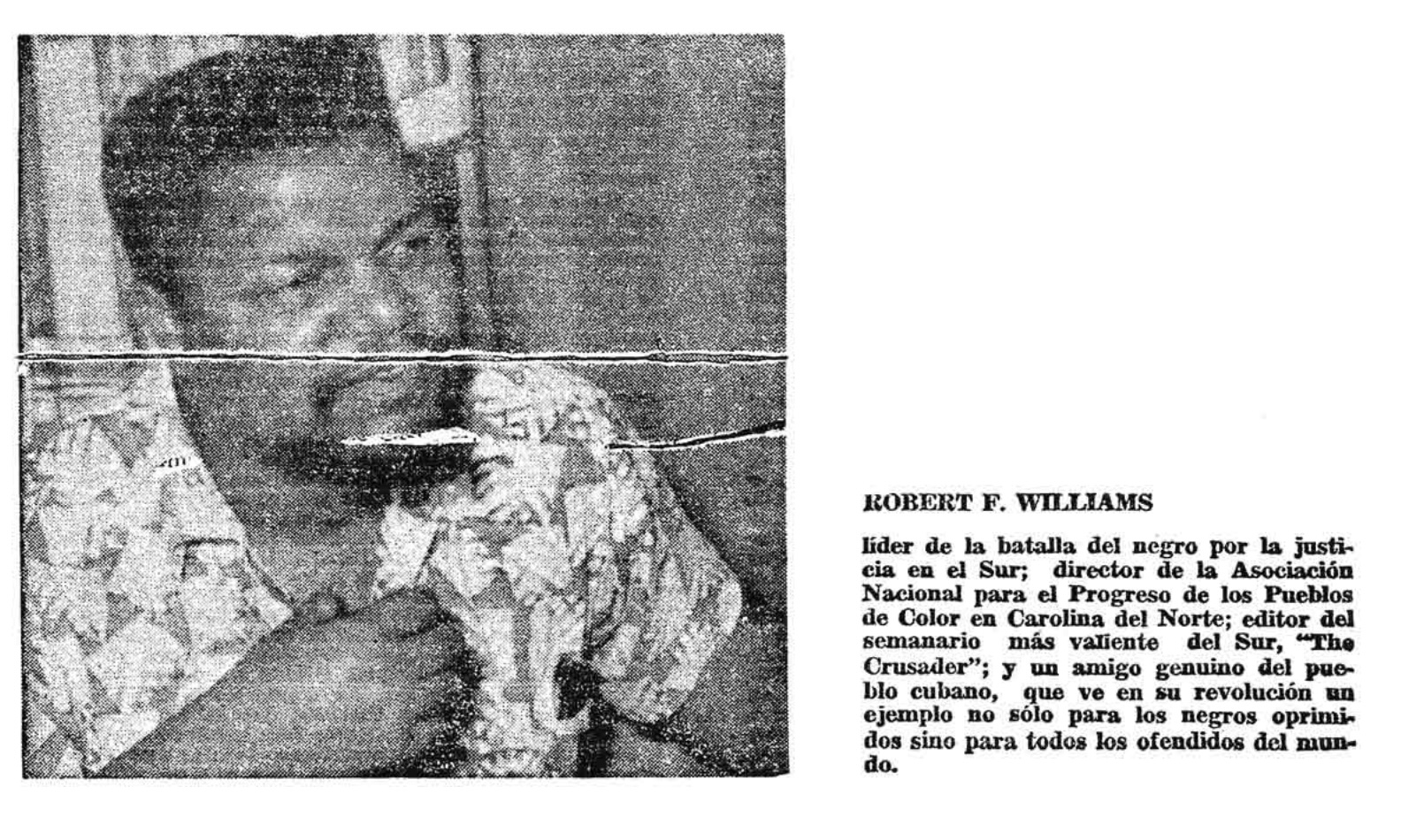
Well, I thought, onward! Let’s look at the next item in the magazine. And then that contributor hit me like a ton of bricks! Robert F. Williams.
It’s almost impossible to summarize the life of Robert F. Williams who grew up in Monroe, North Carolina (the same town where Jesse Helms father was chief of police), and went on to serve in the US Army, the Marines, and become the head of the NAACP chapter for Union County.
Williams’ direct encounters with beatings, lynchings and rapes at the hands of the Klansmen and other racists galvanized him to reorganize his local veterans into an armed self defense force. As you can readily imagine, his comment caused a firestorm: “Negroes must be willing to defend themselves, their women, their children and their homes. They must be willing to die and to kill in repelling their assailants. There is no Fourteenth Amendment, no equal protection under the law. Negroes must protect themselves. It is obvious that the federal government will not put an end to lynching; therefore it becomes necessary for us to stop lynching with violence. We must defend ourselves.”
The NAACP tried to convince Williams to apologize on national t.v., to which he responded, “Go to hell!” Soon, Williams and his wife Mabel were forced to flee from Monroe County and took up residence in Havana, Cuba. It was there, with the support of Fidel Castro, that Robert and Mabel Williams began broadcasting their weekly radio program: Radio Free Dixie, which featured music and social commentary that you wouldn’t find on your average American stations.
At the same time, Williams was the editor-in-exile of the Crusader newsletter, and after spending five years in Cuba, he spent the rest of the 1960s in the People’s Republic of China.
“How were you able to travel around the world?” he was asked in an interview. “You didn’t even have a passport!”
“Yeah, that’s true,” said Williams, “But I had an FBI wanted poster. And that will get you into places that other people cannot go!”
Sticking to his principles, Robert F. Williams wrote and published Negroes with Guns in 1962, in which he made clear that the Black community would never escape from the cruel subjugation that they experienced at the hands of the majority White society if they did not take possession of arms and defend themselves by force. Only brute force was going to change the equation in the savage reality of the United States. Williams actions and writings were as influential as they were incendiary, and became a concrete example to build upon during the formation of the Black Panthers.
If this capsule summary of Robert F. Williams does not leave your head spinning, just listen to him in his own words. Here, for example, is the translation into English (possibly the only one) of Williams contribution to Lunes de Revolucion.
THE CONSTANT STRUGGLE OF BLACK PEOPLE FOR THEIR FREEDOM
BY RICHARD GIBSON AND ROBERT F. WILLIAMS
Ninety-seven years ago, in the midst of a great civil war, slavery was officially abolished in the United States. Today, although slavery has disappeared, many Black people live in feudal conditions, suffering hunger and poverty, and are tyrannized. Even after so many years of struggle, Black Americans still suffer economic discrimination, limitations on their civil rights—notably, the right to vote—and endure the humiliation of a caste system that denies them the essential dignity of being human.
The leading figures of the so-called “free world” find themselves in serious trouble justifying the well-known and irrefutable facts about the living conditions of Black people in the United States. The U.S. Information Agency makes futile efforts to conceal the oppression to which Black people are subjected in the United States. And there are many of the so-called “well-intentioned liberal whites” who struggle to see the conditions in which Black people live in the ghettos of North America. And there are even some Black people—members of the small and insecure middle class—who would like to erase from their memory the stench of the ghetto and the humiliation of having been treated inhumanely. To maintain their precarious privileges, some of these so-called “Black leaders” are willing to sacrifice their own brothers and sisters in sham agreements to appease their white masters. These are the ones who have traveled the world, paid by the U.S. State Department, to try in vain to convince the world that “the Black problem does not exist in the United States.”
There are many well-known Black people whose importance belongs to the past. These figures emerged when Black people desperately sought a solution, an escape route to liberation. These well-known personalities are typical examples of an era in which Black people tried to free themselves from a brutal and oppressive world without creating racial tensions and provoking the wrath of their masters.
“Father Divine” and “Sweet Daddy” Grace are figures linked to a form of religious escapism. This was logical; brutally oppressed people, deprived of education and lacking political maturity, were easy prey for these figures. During the economic depression of the 1930s, in which Black people bore the brunt, Father Divine found many innocent souls willing to be fed and clothed in his “heaven.” Father Divine offered a way out of purgatory, out of a life without providing a solution. It offered a false sense of security to those who preferred to live in a fantasy world rather than face reality. “Daddy” Grace offered them the same formula. Both became millionaires. They have always been very careful not to associate with any movement that truly aims to liberate Black people. One of their constant sermons was to work diligently and remain loyal to their employers. Of course, these practices were fully supported by the ruling classes who exploited Black people.
Thurgood Marshall, head of legal counsel for the National Association for the Advancement of Colored People (NAACP), is primarily a lawyer who, because of his position, is credited with many of the victories won by Black people in court. There are many lawyers responsible for these successes who remain anonymous. However, Thurgood Marshall has become a symbol of Black victories in the courts, and for this reason, he is one of the most respected figures in the Association.
Adam Clayton Powell is a Black congressman and pastor of one of the world’s largest Baptist churches. Although he is known throughout the United States, his true influence lies in Harlem, New York, home to nearly a million Black people. Powell is nothing more than an opportunist who always puts his own interests above those of his fellow Black people—a typical political hack.
Jackie Robinson, the first Black man to play in Major League Baseball, is a very active member of the Association, but he is very conservative and ineffective. Jackie is also vice president of the Chock Full O’ Nuts company, and any Black person who holds a prominent position in a company in the United States must be very careful about what they do and say regarding the struggle for Black liberation. Richard Wright, one of the best-known Black writers, could have contributed greatly to the liberation of his brothers and sisters in the United States; however, he preferred to enjoy the freedom that France offered him and describe the problem from afar rather than submit to the indignities of American racism.
A true fighter for Black freedom becomes a constant target of their white masters. Their livelihood is always in danger. If they become too active and uncompromising, they may be assassinated by the hired thugs of the exploitative whites. Black leaders who have the courage to point out racial injustices are accused of being communists, blacklisted by companies, accused of being agitators, and ultimately, attempts are made to isolate them from their friends and followers. A constant campaign of intimidation is waged against these figures, and the ruling classes like to make an example of them, whenever possible, to prevent such fighters from multiplying.
Similar pressure is currently being exerted against those Americans who show sympathy for the Cuban Revolution. They are accused of being communists, interrogated, intimidated, labeled as “agents of a foreign government” and anti-American. In some cases, they have even received death threats. It is clear that the reason for all this is that the U.S. State Department considers Cuba a bad influence on the exploited and oppressed of the world. Cuba is a living example of the happiness and freedom a people can enjoy when they are free. Cuba is a model of how a democratic government can, if it so chooses, eliminate racial injustice and fascism.
If a Black person opposes racial segregation, they will be subjected to a series of threats and pressures. The Ku Klux Klan, a gang of masked whites who dedicate themselves to intimidating Black people in the most violent way, is the most blatant example of this. But with the growing number of Black organizations, the Klan is increasingly hindered from operating successfully. Black people no longer feel terrified and are ready to defend themselves at any time.
However, there is a clandestine group far more effective than the Ku Klux Klan: the Citizens’ Council. This group, comprised of businessmen and professionals, uses every possible economic means to intimidate Black people. They make life impossible for Black people who adhere to militant principles. Black businessmen cannot purchase goods on credit, and in some cases, they are even unable to acquire the goods they need for their businesses. One of the most prominent figures in the Citizens’ Council is Jim Brady, who held the position of Governor of Alabama. This man, who supposedly dispenses justice to Black people almost daily, declared that a Black person has the mentality of a cockroach.
The AFL-CIO and other unions, which claim to be against racial discrimination, both in the North and South of the United States, are dedicated to systematically eliminating Black people from certain specialized fields. Southern labor unions fully cooperate with the White Citizens’ Council, not only to prevent Black workers from obtaining jobs, but also to ensure they don’t receive industrial training. Because of this, they often argue that Black people are not qualified to fill job vacancies. In some areas, the unions have provided aid and money to private schools for white people, founded by racists in some places to circumvent the U.S. Supreme Court’s May 17, 1954 order that public schools provide access to Black students.
And sometimes it happens that employers are willing to hire Black people, but the unions oppose it. For example, the Confederate Railroad Workers does not accept Black members. Some companies have shown willingness to hire Black engineers and firemen, but this union has so far prevailed: not a single Black person has joined its ranks. Currently, a case is before the courts to force the Confederation of Railroad Workers to cease its discriminatory practices.
Despite the obstinate and cruel opposition of racists, who receive all kinds of encouragement from both federal and state authorities, Black Americans are fighting with more determination than ever. The wave of mass resistance demonstrated throughout the South, the so-called “sit-ins,” directed against segregation in public places, has given rise to a new spirit, especially among young people eager to enjoy all the privileges that democracy can offer, both in the North and the South.
Although popular imagination has identified certain figures, such as Dr. Martin Luther King Jr., as the central figures of this movement, the truth is that there is no such thing. The fact is that King and some white leaders are desperately trying to take advantage of this spontaneous movement.
Many so-called liberals, both white and black, can barely conceal their concern about this new situation. Some interracial groups, such as CORE (Congress for Racial Equality), immediately sent their representatives to the South to try to lead the youth movement. Supported by this and other groups, Dr. Martin Luther King Jr. and other leaders are trying to preach an ideology of absolute passive resistance. They are now asking black people to “pray for their enemies” and to turn the other cheek, instead of defending themselves with force against the aggression of white racists. The course these young people might take frightens both “liberals” and racists. That is why they never tire of repeating that patience is necessary and that a gradual policy should be pursued. But this policy is unlikely to succeed.
These young black people are imbued with a revolutionary spirit, but unfortunately, they lack ideology, national unity, and therefore, a leader. The National Association for the Advancement of Colored People (NAACP) has approximately 300,000 members out of a total of 20,000,000 living in the United States, and it is the most powerful organization available to Black people in the United States. If they were to adapt to the new situation, this organization would surely grow in size and influence.
Black Americans have never been accepted as human beings. Only when they are willing to collaborate with the forces that oppress and exploit their own brothers and sisters are they allowed to enjoy certain material advantages. But maintaining this collaboration becomes increasingly difficult, both for those who are willing to collaborate and for those who need it to maintain their hegemony.
Throughout the world, Black people, especially in Asia and Africa, have rebelled against their white European oppressors. The liberation movement that began in Asia and spread to Africa shows no signs of stopping. The Cuban Revolution has already shown Latin America the path to true independence. And if the rest of the world is to be free, why can’t the United States be free? In many parts of North America, there is as much hunger, poverty, and tyranny as in the worst areas dominated by imperialists. The United States is far from being a true democracy, despite all the displays of bourgeois parliamentarianism that exist in Washington.
However, Americans remain ignorant of their true political and economic situation. Nowhere in the world has a people been subjected to such pernicious propaganda as that provided by the press, radio, and television in the United States. No people live in such an illusory situation as the American people. However, due to the inferior position they occupy in the American caste system, Black people witness daily the difference between the propaganda structure created by the lords of the “Free World” and the sordid reality existing in most of American society.
There are very few Black people are so cynical or hypocritical as to dare claim they are “free and equal” members of the Republic of America. Even wealthy Black people realize how fragile their hard-won prosperity truly is. But the shame of being Black, instilled in their grandparents by their white masters, is fading away, and Black Americans are acquiring a new dignity in their struggle for social justice and human decency.
The example of the Cuban people, who have dared to confront tyranny and imperialism, has served as an inspiration, showing them that they are willing to pay with their lives, if necessary, for the price of freedom. In the Western world, the example of a free Cuba stands as a beacon illuminating both whites and Blacks, who are still struggling in the dark.
ROBERT F. WILLIAMS
References:
Campbell, James, (2006) “The Island Affair” in The Guardian
Lunes de Revolución Internet Archive
Morley, Jefferson (2018-05-15) CIA Reveals Name of Former Spy in JFK Files—And He’s Still Alive in Newsweek
Morrison, John, (2025) “Radio Free Dixie: A revolutionary cultural institution.” Scalawag 5 Aug 2025
Tyson, Timothy, (2001) Radio Free Dixie: Robert F. Williams and the Roots of Black Power
Williams, Robert F., (1959) “Can Negroes Afford to Be Pacifists?” Liberation (Sep 1959) Univ of Texas
Williams, Robert F. “Five Part Interview” RGBStreetScholar Youtube
Williams, Robert F., (1962) Negroes With Guns